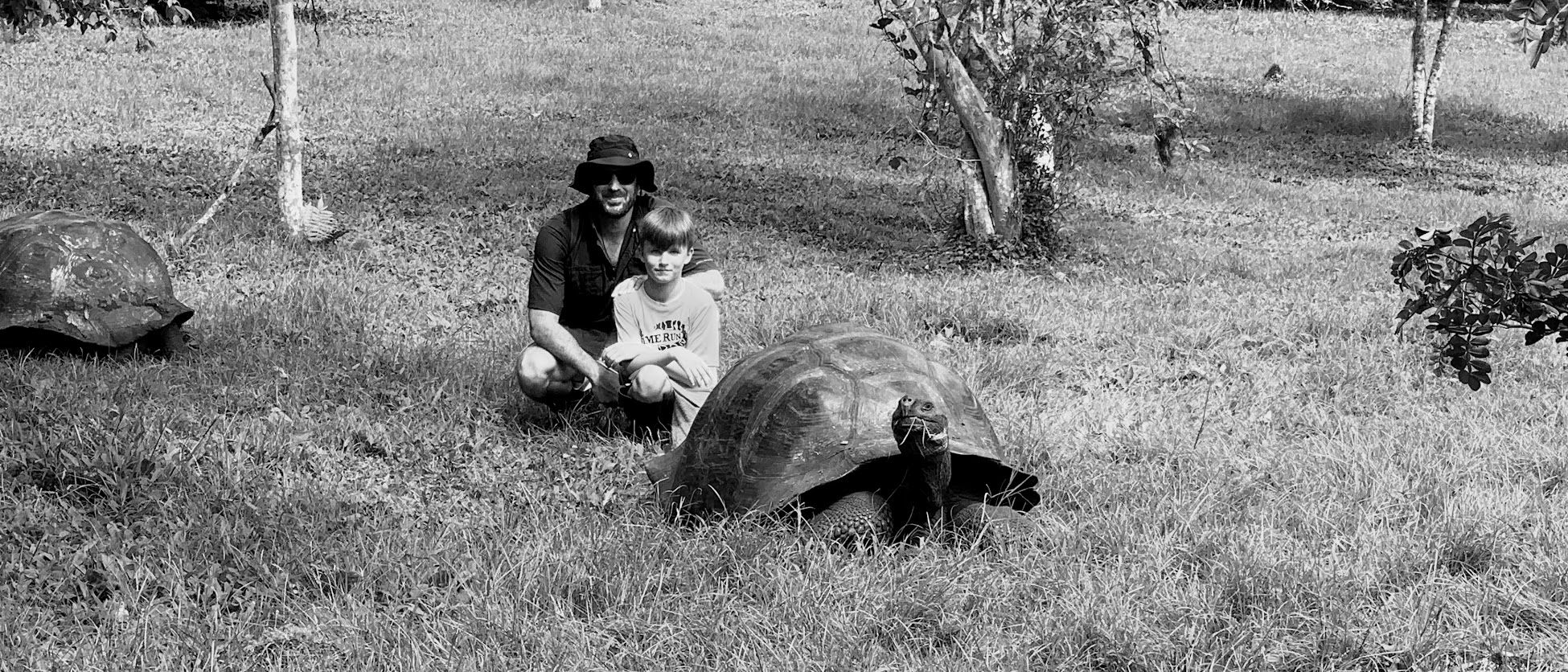
Dear Lucca,
A teenager?!!?!? I can’t believe it.
Seems like yesterday, I used to tell you stories about a man named Leonardo da Vinci on the way to preschool. You’d sit in the back seat, half asleep, while I went on and on about a guy who dissected faces to see how lips move, who watched dragonflies at the edge of a castle moat, and who put “describe the tongue of the woodpecker” on his to-do list.
I used to tell you how Leonardo looked at the branches of a tree and saw the veins in your own body, then saw both of them again in the way a river splits into smaller and smaller streams. He watched the way water curls in a current and found the very same swirl in a person’s hair and in the way blood moves through your heart. He let his mind leap from a bird’s wing to the flow of a stream because he was sure, deep down, that everything is connected.
You ate it up! Then one night we were wrestling before bed and you said, “Dad, you be Batman, and I’ll be Leonardo da Vinci!” I have never been prouder of anything I’ve said in a car.
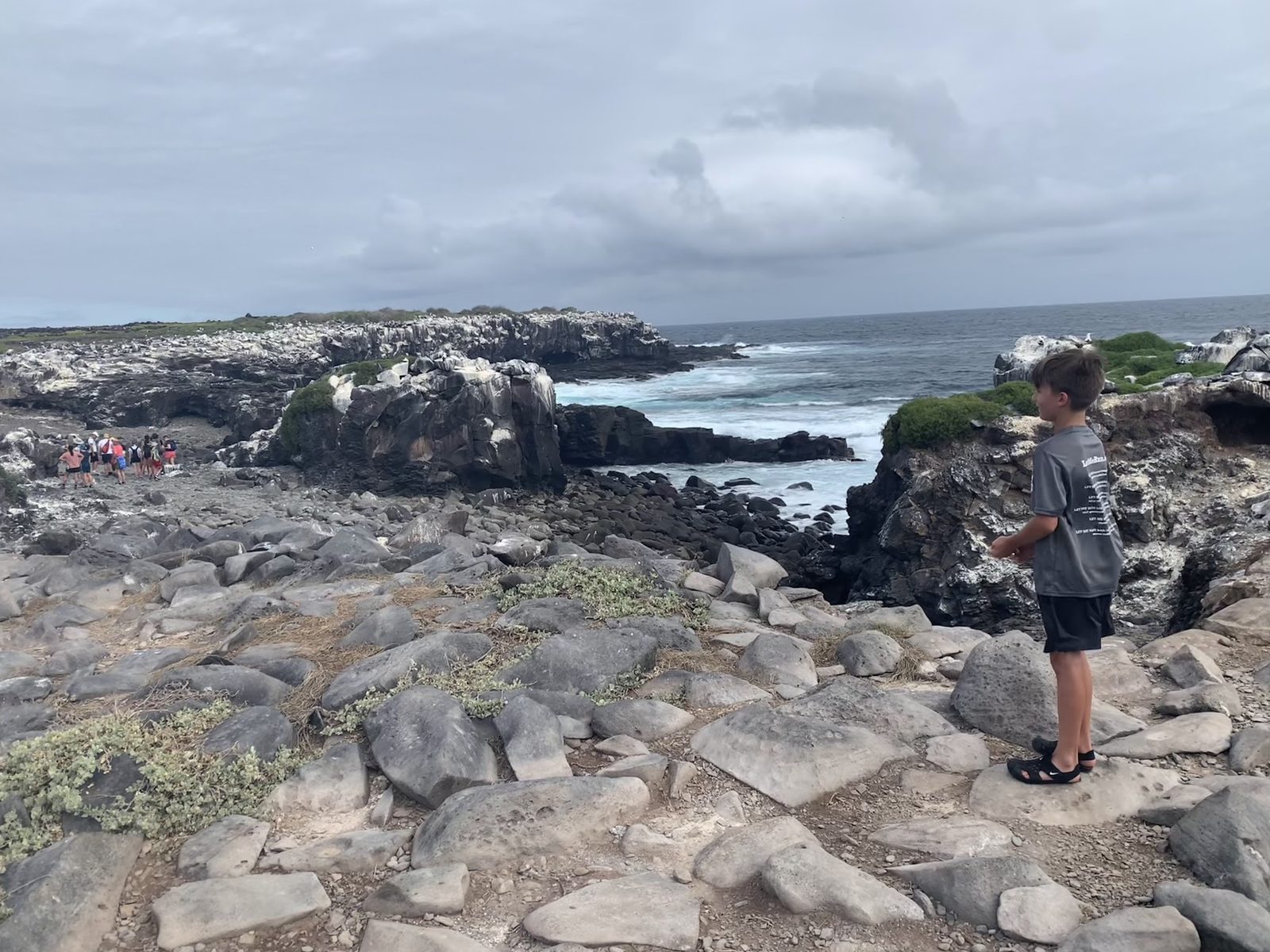
I think it was right then when I decided that you and I were going to take a trip to The Galápagos Islands when you were old enough to really appreciate it. Before that trip, I read everything Darwin published so I could try to be a proper guide. I bought a notebook and a sketchpad just for that trip. Although they didn’t get much use because we were too busy and too exhausted from all of our adventures!! I also started this letter on that trip, inspired by Leonardo, Darwin, and another man I hope you will grow to appreciate just as much, if not more. His name was Edward O. Wilson, and he became one of the most important scientists of his century, doing just what he LOVED.
He spent his whole life on his hands and knees in the dirt, looking at bugs. He turned over rotting logs. He watched insects nobody else thought were worth watching. Sound familiar?
When I first read his book, Letters to a Young Scientist, I couldn’t wait to share it with you! Like all of these letters, I’m embarrassed it’s taken me so long to finish it, but I am forcing myself to do that today, on your 13th birthday.
So, Happy Birthday, Lucca. The greatest gift I could ever give you would be continuing to fuel that fire that has burned inside you since you were a toddler, to encourage you to hang onto that child-like curiosity, and to keep doing what you love. I hope that the excerpts below, with a few words from your Dad in between, can provide another nudge in that direction.
Keep Asking Questions
Here’s the whole secret: science starts the second you notice something strange and ask why. That’s it. That’s the first step, and it’s the one you’ve been taking your entire life. Wilson lays out the rest better than your Dad ever could:
The method starts with the discovery of a phenomenon. The scientist asks: What is the full nature of this phenomenon? What are its causes, its origin, its consequence? Always there are clues, and opinions are quickly formed from them concerning the solutions. These opinions, or just logical guesses as they often are, are the hypotheses. It is wise at the outset to figure out as many different solutions as seem possible, then test the whole, either one at a time or in bunches, eliminating all but one.
Here’s Wilson’s favorite example. He noticed that live ants carry other dead ants out of their nest. Who would even notice that? Nobody. But you. And Wilson, apparently. He stopped and asked himself questions nobody else bothered to ask. First, how does an ant even know another ant is dead? They can’t see anything inside their nest. It’s pitch black! And, second, why do they ignore it completely when it first dies. Then a day or two later, decide they suddenly need to haul it out?
So Wilson made a guess, a hypothesis: he wondered if the ants “smelled” death. It starts with a hunch. Then he decided to test that idea to see if he was right. That’s how you “do” science. So he found the exact chemical produced by decaying bodies and dabbed a tiny bit of it onto a healthy ant.
Guess what happened.
The other ants picked her up, carried her out to the trash pile, and dumped her!! And every time she came back in, they hauled her right back out and dumped her again! This kept happening until the smell finally wore off. How funny is that!?
That’s the whole game. Ask the question nobody’s asking. Forget the picture in your head of a scientist as some guy in a lab coat scribbling equations on a chalkboard. That’s not where the magic happens:
Real progress comes in the field writing notes, at the office amid a litter of doodled paper, in the corridor struggling to explain something to a friend, at lunchtime, eating alone, or in a garden while walking.
The progress you will make will depend entirely on the questions you’ve asked and the knowledge you’ve brought with you. So keep asking questions. And keep seeking answers. You’ll be surprised by the connections you make along the way.
To make important discoveries, it is necessary to acquire a broad knowledge of the subject that interests you, but also the ability to spot blank spaces in that knowledge.
Deep ignorance, when properly handled, is a superb opportunity. The right question is intellectually superior to finding the right answer. When conducting research, it is not uncommon to stumble upon an unexpected phenomenon, which then becomes the answer to a previously unasked question.
To search for unasked questions, plus questions to put to already acquired but unsought answers, it is vital to give full play to the imagination. That is the way to create truly original science. Therefore, look for oddities, small deviations, and phenomena that seem trivial at first but on closer examination might prove important.
Build scenarios in your head when scanning information available to you.
Make use of puzzlement.
In other words, the magic happens on your knees, in the dirt, at the edge of the creek. Exactly where you’ve spent most of your first 13 years!
Put Passion Ahead of Training
Wilson opens with the single best piece of advice in the whole book, and it’s the one I most want you to hear:
It is quite simple: put passion ahead of training. Feel out in any way you can what you most want to do. Obey that passion as long as it lasts. Feed it with the knowledge the mind needs to grow. Sample other subjects and be smart enough to switch to a greater love if one appears. But don’t just drift through courses hoping that love will come to you. Maybe it will, but don’t take the chance. As in other big choices in your life, there is too much at stake. Decision and hard work based on enduring passion will never fail you.
Most people spend their whole lives looking for the thing you already have. Looking for something that lights them up the way you light up when you are outside, doing what you love.
Most people just drift along, waiting for something to happen.
You’re not most people.
You fell in love from the first step you took outside, examining the bugs, creatures, and animals you came across, and building the worlds they live in.
My greatest wish for you today, and as you grow older, is that you continue to feed that love.
You Do Not Have to Be the Smartest Kid in the Room
This is the part I want you to read twice, because it’s the lie that scares most kids away from the things they love.
Ambition and entrepreneurial drive, in combination, beat brilliance. Accomplishments are achieved more by entrepreneurship and hard work than by native intelligence. Most of the time, extreme brightness may be a detriment.
The ideal scientist is smart only to an intermediate degree: bright enough to see what can be done but not so bright as to become bored doing it. One reason could be that geniuses have it too easy in their early training. They don’t have to sweat the courses they take in college. They find little reward in the tedious chores of data-gathering and analysis. They choose not to take the hard roads, over which the rest of us, the lesser intellectual toilers, must travel.
Being bright is not enough for those who dream of success. To reach and stay at the frontier, a strong work ethic is absolutely essential. There must be an ability to pass long hours in study and research with pleasure even though some of the effort will inevitably lead to dead ends. Such is the price of admission.
Even Leonardo, maybe the most gifted human who ever lived, was human. He just looked harder, and longer, than anyone else. His gift was effort. It’s always effort. Or as Einstein himself once admitted, “It’s not that I’m so smart, it’s just that I stay with problems longer.”
So I don’t ever want to hear you say, “I’m not a math person” or “I’m not good at math.” One, because it’s not true. But more importantly, because it doesn’t matter. Darwin flat out admitted he was lousy at math. And Wilson didn’t learn calculus until he was in his thirties!
You can pick anything up as you go. As you grow older, you’ll come to understand that’s what we all do. We are all just making it up as we go along. So don’t ever let that be the reason you walk away from something you love. You’ve heard me say this your whole life: I always hire for drive, for grit, for passion, and for discipline over raw talent, because talent becomes a crutch. The most talented kids assume they don’t have to work for it. Right up until they watch the kid who outworks them go flying by.
It doesn’t matter how many times you fall. What matters is how many times you get up and try again. The willingness to look dumb, to be wrong out loud, to wander off where nobody else is going, that is the smartest thing you can do.
The Whole Universe Is in Your Backyard
The Galápagos Islands are a magical place. But you don’t need the Galápagos to start. You don’t need anything you don’t already have and you’re not already doing.
One of my favorite passages in Wilson’s whole book is the best example of “the work” you’ve been doing your whole life. He talks about a single rotting tree stump in the woods. The kind you have always stopped to look at, driving your Mom and Dad crazy, on almost every one of our hikes!
Consider a rotting tree stump in a forest. You and I casually walking past it on a trail would not give it more than a passing glance. But wait a moment. Walk around the stump slowly, look at it closely, as a fellow scientist. Before you, in miniature, is the equivalent of an unexplored planet.
What you can learn from the decaying mass depends on your training and the science you have chosen to begin your career. Choose a subject, draw on it from anywhere in physics, chemistry, or biology. With imagination you will conceive original research that can be centered on the rotting stump.
Start with animals. There may be cavities in the side, or at the base or beneath the roots, large enough to hold a mouse-sized mammal, and if not, surely a frog, salamander, snake, or lizard. Let us next magnify the image to bring in insects and other invertebrates one millimeter to thirty millimeters in length. We can see most of them with unaided vision. They are each distributed according to niches for which millions of years of evolution have adapted them. A large minority are insects.
An entomologist trained in taxonomy will point out beetles that live here. More species of beetles are known than any other comparable group of organisms in the world. Yet even though the most diverse, they are not the most abundant in individuals. If the stump is well along in decomposition, ant colonies will be there, resting in the frass beneath the bark and among the roots below. Termites may riddle the heartwood.
In the crevice and over the surface can be found bark lice, springtails, proturans, fly and moth larvae, earwigs, japygids, and symphylans. Around them a myriad of other rotting-stump invertebrates other than insects: crustacean pill bugs, tiny annelid worms, centipedes of varying sizes and shapes, slugs, snails, pauropods, and a huge fauna of mites, the numbers of the latter dominated by sluggish spherical oribatids with a sprinkling of wolfish, fast-running phytoseiids. Spiders of many kinds spin webs or hunt widely on foot.
In patches of moss and lichens that grow on the surface of the stump, little worlds of their own, roam the aforementioned tardigrades, also called bear-animalcules for their body shape midway between caterpillars and miniature bears. Among these animals are the most abundant of all: the nematodes, also called roundworms, most barely visible. Worldwide, roundworms are reckoned to make up four-fifths of all the individual animals.
Keep in mind that a distinguished career can be built from any species, by means of contributions to different disciplines within biology, chemistry, and even physics. Karl von Frisch, the great German entomologist who made many discoveries concerning the honeybee, including their symbolic waggle-dance communication and their remarkable memory of place, knew that he had only begun to explore the biology of this single insect species.
“The honeybee is like a magic well. The more you draw, the more there is to draw.”
The creek at the cabin. The lizard tanks. The stones you’ve been flipping over since you started walking. The trick isn’t getting somewhere exotic. The trick is looking closely at what’s already in front of you, the way you already do.
Well, maybe getting somewhere exotic helps a little. :)
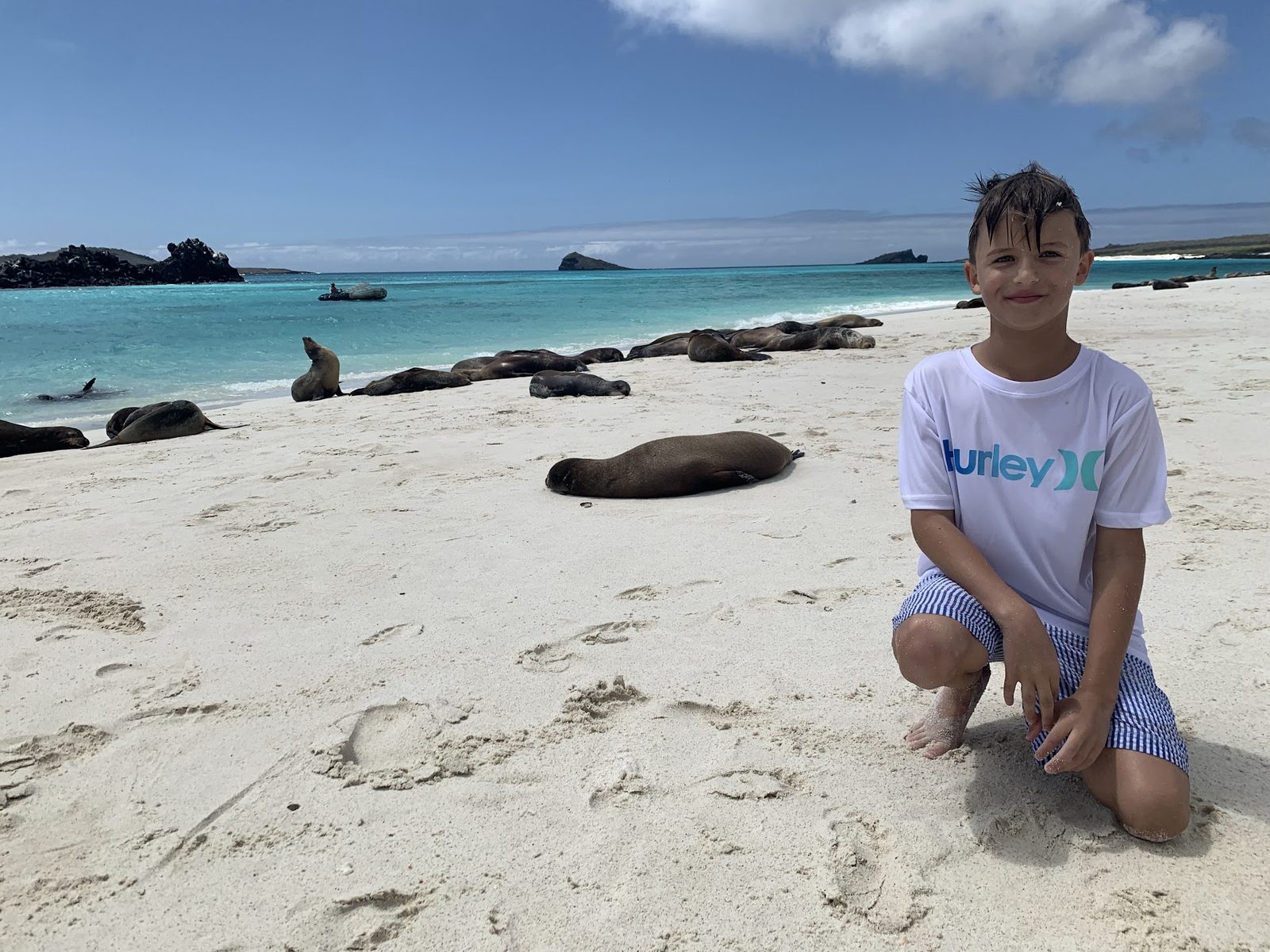
The Galápagos Islands are one of the most special places in the world. And a trip we’ll never forget. I couldn’t join you in Africa, but I’m sure you lit up on that continent as bright as you did in South America. So maybe we need to find out by scheduling another trip before you are too old! You have talked about the rain forests, and their poison dart frogs, since you started talking! Seems like that’s another thing you have in common with Wilson.
In the Amazon rain forest, one of the world’s strongholds of biological diversity and massed living tissue, ants alone weigh more than four times that of all the land-dwelling vertebrates combined. In the Central and South American forests and grasslands alone, one taxonomic group of ants, the leafcutters, collect fragments of leaves and flowers on which they rear fungi for food, making them the leading consumers of vegetation. In the savannas and grasslands of Africa, mound-building termites also rear fungi and are the primary animal builders of the soil.
Although insects, spiders, mites, centipedes, millipedes, scorpions, proturans, pillbugs, nematodes, annelid worms, and other such lilliputians are ordinarily overlooked, even by scientists, they are, nonetheless the “little things that run the world.” If we were to disappear, the rest of life would flourish as a result. If on the other hand the little invertebrates on the land were to disappear, almost everything else would die, including most of humanity.
You don’t have to swallow it all at once. Take it one piece at a time. Leonardo said, “Deep observation must be done in steps. Begin with the details of them, and do not go on to the second step until you have the first well fixed in memory.”
That’s how he caught a dragonfly beating its front wings and its back wings opposite to each other. You only notice something like that if you sit and watch one bug long enough to bore a normal person to death. But you are not a normal person. This is your specialty. And one of the MANY reasons I have loved watching you grow up.
March Away From the Sound of the Guns
You have heard the military rule for the summoning of troops to the battlefield: march to the sound of the guns. In science the opposite is the one for you. March away from the sound of the guns. Observe the fray at a distance, and while you are at it, consider making your own fray.
Wilson chose ants because nobody else was looking at them. While everyone crowded around the most popular, most glamorous subjects, he went where it was quiet. And that’s exactly why he got to be the world’s authority on them so young.
You’ve marched to your own guns since you were born. You’ve never cared what anybody else was doing or what anybody else thought about what you were doing. Another wish for you as you come into your teenage years: don’t lose that! Do what makes you happy. Whatever that is. Don’t worry about what everyone else is doing. What makes them happy is not the same as what makes you happy. And quite frankly, what everyone else is doing, probably isn’t making them happy either!
You figured this out for yourself very early in life. Don’t ever forget it.
And for what it’s worth, the same advice has been just as valuable for your Dad. And I have used almost exactly this same line describing how I invest: “We operate outside the fray.” It’s human nature to want to be part of the group. That’s why everybody piles into the same investments at the same time. It’s also why the bargains are always somewhere off to the side, or under a rock, where nobody’s looking. The crowd is rarely where the opportunity is.
Think Like a Poet
This is the idea that ties your whole world to mine, and it’s my favorite line in the book.
The ideal scientist thinks like a poet and only later works like a bookkeeper.
Innovators in both literature and science are basically dreamers and storytellers. In the early stages of the creation of both literature and science, everything in the mind is a story. There is an imagined ending, and usually an imagined beginning, and a selection of bits and pieces that might fit in between.
In works of literature and science alike, any part can be changed, causing a ripple among the other parts, some of which are discarded and new ones added. The surviving fragments are variously joined and separated, and moved about as the story forms. One scenario emerges, then another. The scenarios, whether literary or scientific in nature, compete with one another. Some overlap. Words and sentences (or equations or experiments) are tried to make sense of the whole thing. Early on, an end to all the imagining is conceived. It arrives at a wondrous denouement (or scientific breakthrough). But is it the best, is it true?
To bring the end safely home is the goal of the creative mind. Whatever that might be, wherever located, however expressed, it begins as a phantom that rises, gains detail, then at the last moment either fades to be replaced, or, gains strength. Inexpressible thoughts throughout flit along the edges. As the best fragments solidify, they are put in place and moved about, and the story grows until it reaches an inspired end.
By pleasure drawn from discovery of new truths, the scientist is part poet, and by pleasure drawn from new ways to express old truths, the poet is part scientist. In this sense science and the creative arts are foundationally the same.
I’ve quoted this exact section in our investment letters and in presentations I’ve given on creativity. “Investing certainly requires that we ‘do math’ … but it’s not rocket science. Most of the ‘real work’ in science and in investing requires little more than basic math skills. The ‘real work’ is done here. Successful investing demands that we think differently. That we see differently.”

Science, art, and even investing all start with an idea and only later get pinned down with the careful, boring, work. So the daydreaming you do, the building of whole worlds in your head, or outside, isn’t a distraction from the real work. It IS the real work.
Everyone daydreams like a scientist at one level or another. Ramped up and disciplined, fantasies are the fountainhead of all creative thinking.
Newton dreamed, Darwin dreamed, you dream. The images evoked are at first vague. They may shift in form and fade in and out. They grow a bit firmer when sketched as diagrams on pads of paper, and they take on life as real examples are sought and found.
Pioneers in science rarely make discoveries by extracting ideas from pure mathematics. Most of the stereotypical photographs of scientists studying rows of equations written on blackboards are instructors explaining discoveries already made.
Real progress comes in the field writing notes, at the office amid a litter of doodled paper, in the corridor struggling to explain something to a friend, at lunchtime, eating alone, or in a garden while walking. To have a eureka moment requires hard work. And focus.
To know how scientists engage in visual imagery is to understand how they think creatively. But be prepared mentally for some amount of chaos and failure. Waste and frustration often attend the earliest stages. When a workable idea emerges, the research becomes more routine, and also much easier to think about and explain to others. This is the most enjoyable part.
Make it a practice to indulge in fantasy about science.
Make it more than just an occasional exercise.
Daydream a lot.
Make talking to yourself silently a relaxing pastime.
Give lectures to yourself about important topics that you need to understand.
Talk with others of like mind.
By their dreams you shall know them.
The best scientists, the best investors, and the best artists all use the same trick: they see patterns that connect things nobody else thought to put together.
And they are able to do that, because they march to the beat of their own drum. Just like you’ve always done, and I hope you always do. That can feel lonely sometimes. I know. Being creative often means being different. But trust me. That’s not a problem. It’s a blessing. So if you’ve ever felt like the odd one out, read this again.
I believe the creative process arises and germinates in a solitary brain. It commences as an idea and, equally important, the ambition of a single person who is prepared and motivated to make discoveries in one domain or another. The successful innovator is favored by a fortunate combination of talent and circumstance, and is socially conditioned by family, friends, teachers, and mentors, and by stories of great scientists and their discoveries. He is sometimes driven by a passive-aggressive nature, and sometimes an anger against some part of society or problem in the world.
There is also an introversion in the innovator that keeps him from team sports and social events. He dislikes authority, or at least being told what to do. He is not a leader in high school or college, nor is he likely to be pledged by social clubs.
From an early age he is a dreamer, not a doer. His attention wanders easily. He likes to probe, to collect, to tinker. He is prone to fantasize. He is not inclined to focus. He will not be voted by his classmates most likely to succeed.
About Character
The last thing Wilson teaches you has nothing to do with ants or labs. It’s about character, and it’s the one thing your Dad cares about more than any grade you’ll ever bring home.
You will make mistakes. Try not to make big ones. Whatever the case, admit them and move on. A simple error will be forgiven if publicly corrected. But never, ever will fraud be forgiven. The penalty is professional death.
Bestow credit where it is deserved, and expect the same from others. Honest credit carefully given matters enormously. Granting it to a rival, especially one you do not like and at the risk of your own recognition, would be true nobility.
Admit your mistakes fast. Never cheat. Never lie. Not once. Not even small. Give other people credit, especially the ones you’d rather not. That’s not science. That’s life. That’s how to be a man people trust, and trust is the only thing you really build over a whole life. It takes years and years to accumulate, but can be lost in a second. Don’t lose it.
What Comes Next
You already have the rarest and most valuable thing in the world: you know what you love. Wilson spent a whole book telling young people how to find it. You found it before you could read. Maybe even before you could walk!
You didn’t wait until you were an expert. You didn’t wait for the perfect equipment. You just messed around! And that’s exactly what you should keep doing. You have Wilson’s permission to keep doing it. To keep messing around!
It is all right and potentially very productive just to mess around. Quick uncontrolled experiments are very productive. They are performed just to see if you can make something interesting happen. Disturb Nature and see if she reveals a secret.
Disturb Nature and see if she reveals a secret. Put that one on your wall. Flip the rock. Move the log. Change one thing in the tank and watch what the lizard does. Most of it won’t work, and that’s the point. Some things will lead to dead ends. But every so often you’ll catch something in the corner of your eye. And when you do, grab it!
Wherever your research takes you, stay restless. Continue to move about intellectually in search of new problems and new opportunities.
Happiness awaits those who can find pleasure while working on the same subject all their careers. Once deeply engaged, a steady stream of small discoveries is guaranteed. Stay alert for the main chance that lies to the side. There will always be the possibility of a major strike, some wholly unexpected find, some little detail that catches your attention that might very well, if followed, enlarge or even transform the subject you have chosen. If you sense such a possibility, seize it. In science, gold fever is a good thing.
Why I’m Giving You This Today
The better emotions of our nature are felt and examined and understood more deeply during maturity, but they are born and rage in full intensity during childhood and adolescence. Thereafter they endure through the rest of life, serving as the wellsprings of creative work.
Lucca,
You have always had a special connection with nature. I used to think you’d grow out of it. I hoped you wouldn’t but the reality is that most kids do. But as I’ve said here, and as I hope you’ll come to appreciate, you are not most kids.
At thirteen, you still have that eyes-wide-open, can’t-look-away, have-to-know-everything feeling. It’s not a phase you’ll grow out of. It’s the well that everything else gets drawn from for the rest of your life. And there is so much to look forward to, if you keep drawing from that well.
You and I already stood on the same black rocks where a young guy named Charles Darwin once stood and noticed that the mockingbirds were a little different from one island to the next. He didn’t have a fancy degree or a lab. He just had a notebook. And he just paid attention. He asked why. And that one question changed how every human being understands life on Earth.
We walked where he walked. That still blows my mind. And it blew Wilson’s too.
The frontier of scientific knowledge is reached with maps drawn by earlier investigators.
Even before Newton held up a prism to a sunbeam and Darwin puzzled over variation among the Galápagos mockingbirds. It was also Newton who famously said, for all scientists into the future, “If I see further than others, it is by standing on the shoulders of giants.”
The researchers of my generation and others before you accomplished a lot. But they did not close all pathways. Instead, they opened new ones. In science every answer creates many more questions.
I hope it continues to blow yours, bud. Because there is so much left to find. We can see further now, by standing on the shoulders of giants. Darwin is one of your giants. So is Wilson. So is Leonardo. You get to climb up on all of them and see more than any of them ever could.
Keep climbing. Keep looking. Keep exploring. And most importantly, keep being you.
I loved watching you as the toddler, squatting in the dirt, studying every bug you could find. And I love watching you as a teenager doing the same thing, staring at things nobody else even notices, even more!
Nearly a decade ago, you wanted to be Leonardo. You don’t have to pretend anymore. You already are.
Now go turn over a rock and see what’s under it.
Happy birthday, bud.
We love you more than you could ever imagine.